Round Rock History: How 2026 Pioneer Day Brought Buffalo Soldier History to Life
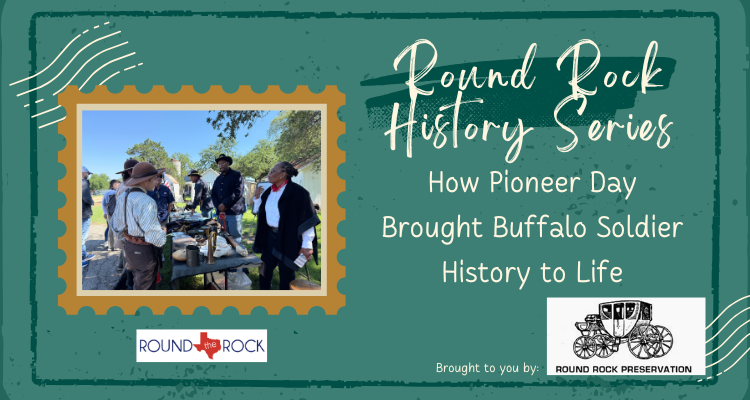
This year’s Pioneer Day at Old Settlers Park, put on by the Williamson Museum on May 2, was amazing. It was filled with so many things to do, learn, and see. But what stood out to me was the group of reenactors of the Buffalo Soldiers. They had tables filled with artifacts and reproductions of items that they used in their daily lives. And the stories were so interesting and exciting. It left me wondering why I hadn’t ever heard of them. Here is what I learned.

The Buffalo Soldiers were African American soldiers who served in the United States Army after the Civil War, primarily from 1867 through the 1890s, with some units continuing into the early 20th century. They were created by an 1866 act of Congress that authorized six segregated regiments. These men were largely formerly enslaved individuals or the sons of enslaved people, along with free Black men from states such as Louisiana, Kentucky, and Kansas. The nickname “Buffalo Soldiers” was given to them by Native American tribes, likely as a sign of respect for the soldiers’ fighting ability and strength.
In Texas—especially central Texas—Buffalo Soldiers played a crucial role during the Reconstruction era and westward expansion. After the Civil War, the region was still unstable. Conflicts between settlers, Native American tribes, and outlaws were common, and law enforcement was limited across the vast frontier. Buffalo Soldiers were stationed at forts throughout Texas, including Fort Richardson, Fort Griffin, and Fort Concho, and served across a wide swath of the state.
Their duties were wide-ranging and physically demanding. They escorted wagon trains, protected settlers and railroad crews, recovered stolen livestock, built roads and telegraph lines, and pursued bandits and raiding parties. They also participated in campaigns against Native American tribes during the Indian Wars, which were part of the federal government’s efforts to control and settle the western frontier.
Their duties were wide-ranging and physically demanding. They escorted wagon trains, protected settlers and railroad crews, recovered stolen livestock, built roads and telegraph lines, and pursued bandits and raiding parties. They also participated in campaigns against Native American tribes during the Indian Wars, which were part of the federal government’s efforts to control and settle the western frontier.

In Round Rock, their presence was especially important because the town sat along the famous Chisholm Trail, a major cattle-driving route established after the Civil War. This corridor brought economic growth—but also danger. Cattle drives attracted rustlers, outlaws, and violence. Buffalo Soldiers helped maintain order in central Texas by patrolling these routes, protecting livestock, and ensuring safe passage for settlers and commerce.
They were needed not only for security but also because local and state systems were overwhelmed or underdeveloped. Federal troops provided a stabilizing force in a region transitioning from frontier to organized settlement. Despite facing discrimination within the Army and society, Buffalo Soldiers developed a reputation for discipline, resilience, and effectiveness, earning respect for their service under difficult conditions.
So, next year, if you have the opportunity to go to Pioneer Day, make sure to stop by and visit the Buffalo Soldiers. You will be inspired by a group of people who are dedicated and proud of their heritage.
Authored by: Amy Petrovick, Round Rock Preservation (RRP) Board of Directors
Copy and images provided by Round Rock Preservation.
Exploring how Round Rock came to be!
Discover the rich history of Round Rock through our Round Rock History Series, brought to you by the Round Rock Preservation organization. The series highlights the people, places, and events that shaped our community. From early settlers to significant landmarks, we explore the stories that connect us to the past. Join us as we uncover the moments that made Round Rock what it is today.
Have something you’d like us to consider sharing? Email us!
Click below for more Round Rock history articles!